My Planet View · Country guide
Netherlands
Canals, bulb fields and Dutch masters, close together and easy to reach by bike or train.
- Best months
- Apr–Sep
- Last checked
- 16 November 2026

Overview
The Netherlands is small, flat and crowded, and about a quarter of it lies below sea level, kept dry by dykes, pumps and the windmills that once drained it. Amsterdam's canals and museums draw most visitors, but Rotterdam, The Hague, Utrecht, Delft, Leiden and Haarlem are all within an hour or so by train, and the countryside has bulb fields, cheese towns, dunes and islands.
Bikes outnumber people, and cycling is the easiest way to get round towns and the countryside alike. "Holland" is strictly just two of the twelve provinces, North and South Holland. This page covers the European Netherlands, not the Caribbean islands that are also part of the kingdom.

When to go
- January: Good
- February: Good
- March: Good
- April: Best
- May: Best
- June: Best
- July: Best
- August: Best
- September: Best
- October: Good
- November: Good
- December: Good
- Best
- The most pleasant weather for sightseeing and being outdoors.
- Good
- Fine for a visit, with a catch (heat, rain, cold or crowds) named below.
- Avoid
- Most visitors would find it hard going: extreme heat, storms or much of it closed.
Season by season
Spring (March to May)
Cool, bright and often breezy, warming through May. The bulb fields flower from late March, with tulips at their peak in mid to late April, and King's Day on 27 April fills Amsterdam.
Summer (June to August)
Warm but rarely hot, usually around 20–23°C, with long light evenings: the best time for cycling, the beaches and the islands. Amsterdam is at its busiest, and its hotels at their dearest.
Autumn (September to November)
September is often mild and settled. Wind and rain pick up from October, and November is grey and damp, though the museums and cafés carry it well.
Winter (December to February)
Grey, damp and windy, around 5–6°C by day, with frost some nights and snow only now and then. December brings Sinterklaas, Christmas lights and the Christmas markets in the caves at Valkenburg. A hard frost that freezes the canals for skating has become rare.
The weather
Mild and damp, with wind off the North Sea. Summer days are usually around 20–23°C and winter days around 5–6°C. Rain is spread through the year, mostly as showers, and the flat land lets weather blow through quickly; the coast is the windiest part.
Festivals and holidays
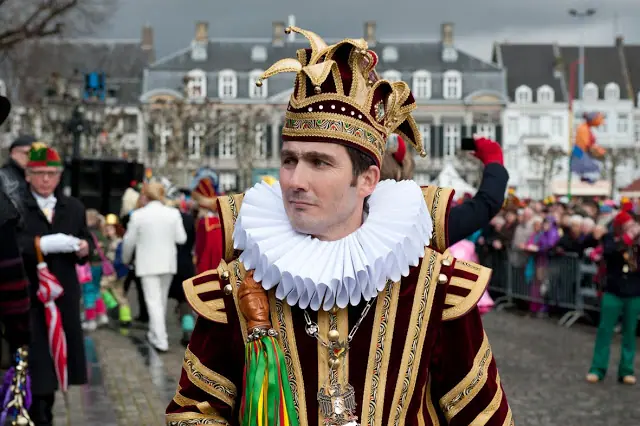
Photo: Hazelares, CC BY-SA 3.0 Carnaval
The days before Ash Wednesday, in February or March · The south, above all Maastricht and Den Bosch
Costumes, brass bands and parades take over the Catholic south, and Den Bosch renames itself Oeteldonk for the occasion. North of the big rivers it passes almost unnoticed.
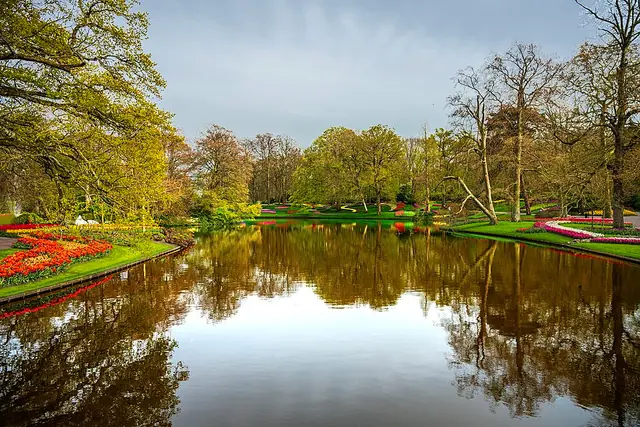
Photo: Urdulife, CC BY-SA 4.0 Tulip season and Keukenhof
Keukenhof usually opens from mid-March to mid-May; the fields peak in mid to late April · Keukenhof, Lisse, and the bulb fields between Leiden and Haarlem
Keukenhof's gardens show millions of bulbs in flower, and the fields around them turn into stripes of colour. A flower parade (Bloemencorso) runs from Noordwijk to Haarlem on a Saturday in April. Keukenhof sells timed tickets online, and weekday mornings are quietest.
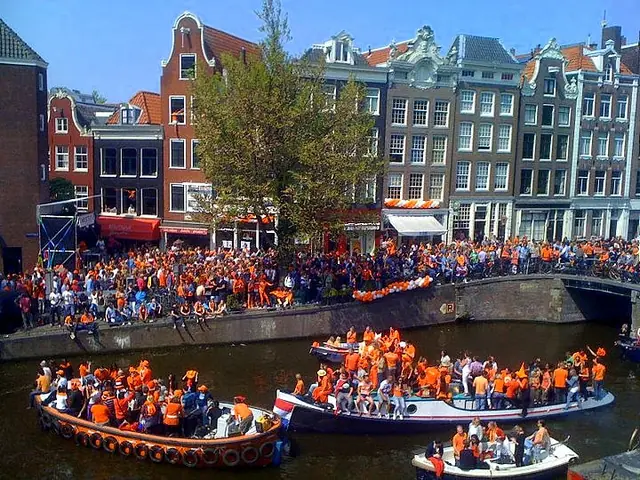
Photo: Carmelrmd, CC BY-SA 3.0 King's Day (Koningsdag)
27 April (26 April when the 27th is a Sunday) · Across the country, above all Amsterdam
The King's birthday: everyone wears orange, the streets become one big flea market where anyone may sell, and Amsterdam's canals fill with party boats. Trains and city centres are packed.
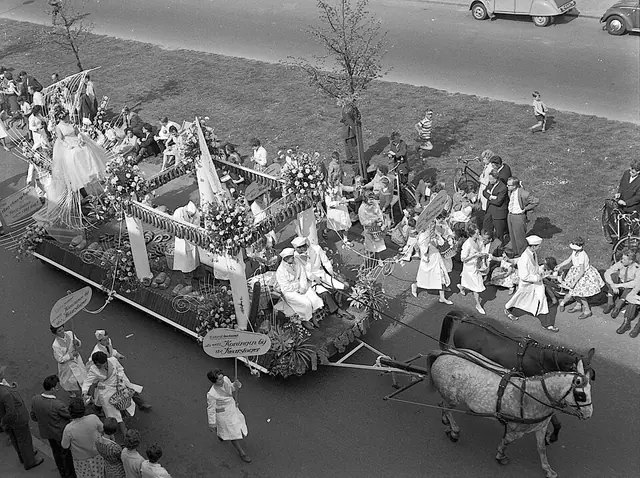
Photo: Wouter Hagens, CC BY-SA 3.0 Remembrance and Liberation Day
4 and 5 May · Across the country
At 8 pm on 4 May the country falls silent for two minutes for the war dead. The next day marks the end of the German occupation in 1945, with free open-air music festivals in many cities.
Pride Amsterdam
Usually late July to early August, with the Canal Parade on the first Saturday of August · Amsterdam
A week or more of events ending in the Canal Parade, when decorated boats sail along the Prinsengracht and the Amstel past huge crowds on the banks.

Photo: CrazyPhunk, CC BY-SA 3.0 Sinterklaas
From his arrival by boat in mid-November to the evening of 5 December · Across the country
Saint Nicholas arrives by steamboat, from Spain as the story goes, and rides through towns on a white horse. On 5 December (pakjesavond) families swap presents and teasing poems. Shops fill with chocolate letters and spiced pepernoten.


How regions differ
Amsterdam
Canals, the Rijksmuseum, the Van Gogh Museum and the Anne Frank House, which sells tickets only online, often weeks ahead. Busy all year and expensive to stay in; Haarlem and Utrecht are short train rides away and calmer.
The other Randstad cities
Rotterdam's modern architecture and port, The Hague's Mauritshuis (home of Vermeer's Girl with a Pearl Earring) and seaside at Scheveningen, and the old canal towns of Delft, Leiden and Utrecht. All are good in any season.
The coast and the Wadden Islands
Long sandy beaches and dunes run the length of the North Sea coast, and the Wadden Islands, Texel the biggest, are a ferry ride from the north. They're at their best from May to September.
Limburg and the south
Maastricht and the green hills of south Limburg, the highest ground in the country, with a slower pace, food and drink taken seriously, and the biggest carnival.
Culture and customs
Greetings
A handshake when you meet someone, with your first name. Friends greet each other with three kisses on alternate cheeks, though fewer people do it than before. The Dutch are known for being direct: a frank opinion is meant as honesty, not rudeness.
Tipping
Service is included, and tipping is modest. Round up or leave 5 to 10% for good table service; nothing is expected at a bar or for a coffee at the counter.
What to wear
Casual and practical: layers and a rain jacket in every season, something windproof for the coast, and comfortable shoes for cobbles and a lot of walking. Tidy clothes are enough for churches.
Etiquette
- Keep out of the cycle lanes, which are often red, and look both ways for bikes before stepping off the pavement. A ringing bell means move, now.
- A coffeeshop sells cannabis, which is tolerated rather than legal; for coffee, look for a café. Rules differ by city: Amsterdam bans smoking it in the street in the red-light district, and some towns near the borders turn away visitors from abroad.
- Don't photograph the women working in the windows of the red-light districts.
- On trains, trams and buses, tap in and out with the same contactless bank card or phone (OVpay). Forget to tap out and you're charged a higher fare.
- Be on time, and expect plans to be made in advance, even among friends. Splitting the bill is normal.
- Canal houses have very steep, narrow stairs, often with no lift, so pack light if you're staying in one.
What to eat
- Raw herring (haring)
- Salted raw herring from street stalls, with chopped onion and pickles, eaten held by the tail or in a soft roll (broodje haring). The new season's catch, Hollandse Nieuwe, arrives in June.
- Bitterballen
- Crisp, deep-fried balls of meat ragout, dipped in mustard and eaten with a beer. Their bigger cousin, the kroket, is sold in a roll or from a wall of vending hatches.
- Cheese
- Gouda, Edam and aged cheeses with crystals in them, from cheese shops everywhere. Alkmaar and Gouda hold traditional cheese markets for visitors from spring to late summer.
- Stamppot
- A winter dish of potato mashed with kale, sauerkraut or carrots and onion, served with smoked sausage (rookworst) and gravy.
- Stroopwafels and poffertjes
- Thin waffles sandwiched with caramel syrup, best warm from a market stall, and tiny fluffy pancakes with butter and icing sugar.
- Rijsttafel
- An Indonesian "rice table" of a dozen or more small dishes, from the country's colonial past; Amsterdam and The Hague have the best-known restaurants for it.
A few words of Dutch
Almost everyone speaks good English, and many will switch to it as soon as they hear your accent, but a few words of Dutch are still appreciated. The Dutch "g" is a rasping sound in the throat, like the "ch" in Scottish "loch" (written "kh" below).
| Phrase | Say it | Meaning |
|---|---|---|
| Hallo | HAH-loh | Hello |
| Goedemorgen | khoo-duh-MOR-khun | Good morning |
| Dank je wel | dahnk yuh VEL | Thank you |
| Alstublieft | ahl-stew-BLEEFT | Please; here you are |
| Spreekt u Engels? | spraykt ew ENG-uls | Do you speak English? |
| Wat kost het? | vat KOST ut | How much is it? |
| Proost! | prohst | Cheers! |
| Lekker | LEK-er | Tasty; nice (said of almost anything good) |
Landmarks in the Netherlands
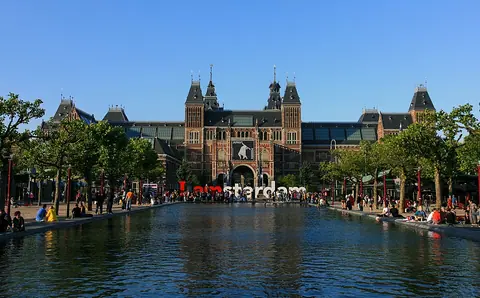
Photo: Marco Almbauer, CC BY-SA 3.0 building
Rijksmuseum
Add a photo taken within 300 m of it, with its location saved, and your map suggests this landmark for it.
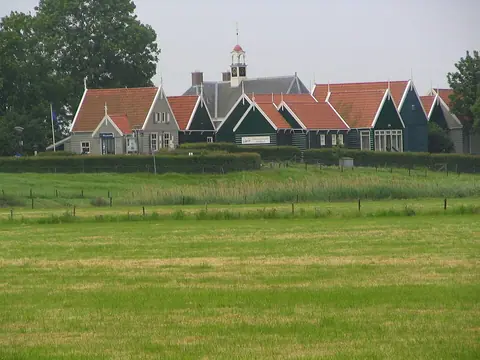
Photo: GerardM, CC BY-SA 3.0 site
Schokland
Add a photo taken within 2.5 km of it, with its location saved, and your map suggests this landmark for it.
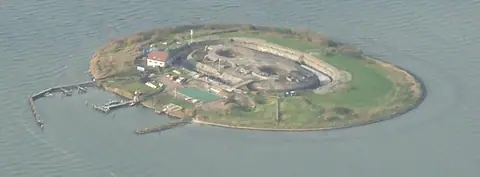
Photo: Debot at Dutch Wikipedia, CC BY-SA 3.0 site
Dutch Water Defence Lines
Add a photo taken within 15 km of it, with its location saved, and your map suggests this landmark for it.
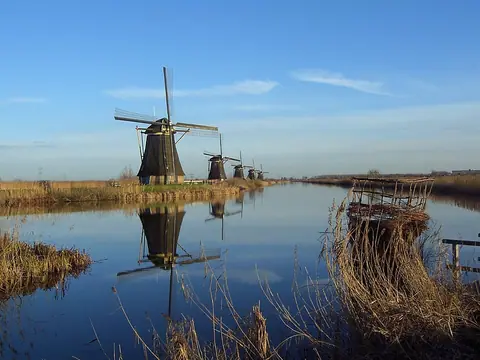
Photo: Lucas Hirschegger, CC BY-SA 3.0 site
Kinderdijk Windmills
Add a photo taken within 1.4 km of it, with its location saved, and your map suggests this landmark for it.
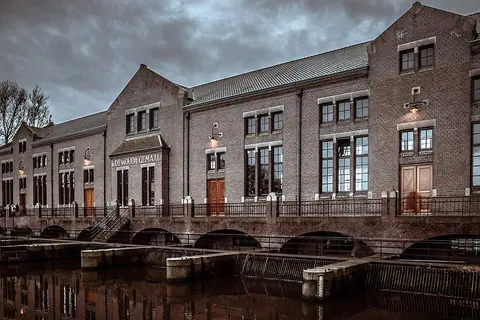
Photo: Uberprutser, CC BY-SA 3.0 nl building
D.F. Wouda Steam Pumping Station
Add a photo taken within 400 m of it, with its location saved, and your map suggests this landmark for it.
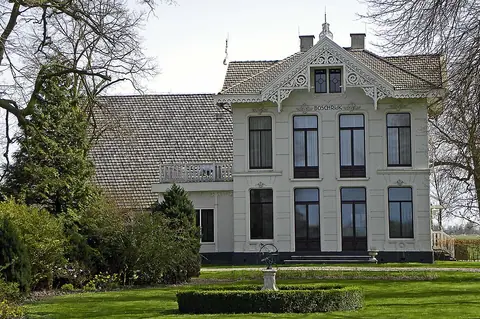
Photo: Arhu, CC BY-SA 3.0 old town
Beemster Polder
Add a photo taken within 1.5 km of it, with its location saved, and your map suggests this landmark for it.
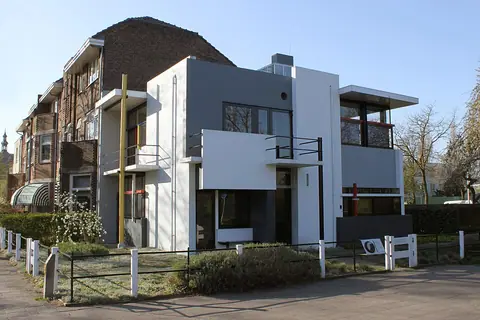
Photo: User:Husky, CC BY 3.0 building
Rietveld Schröder House
Add a photo taken within 500 m of it, with its location saved, and your map suggests this landmark for it.
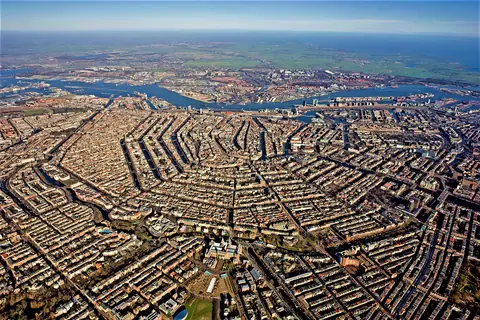
Photo: Andrés Barrios, CC BY-SA 4.0 old town
Amsterdam Canal Ring
Add a photo taken within 2 km of it, with its location saved, and your map suggests this landmark for it.
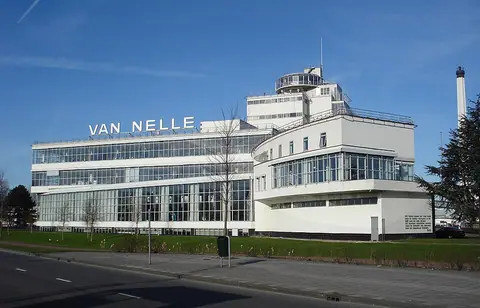
Photo: F.Eveleens, CC BY 3.0 building
Van Nelle Factory
Add a photo taken within 400 m of it, with its location saved, and your map suggests this landmark for it.


Practical facts
- Currency
- Euro (€). Cards, including contactless, are taken almost everywhere, and some shops and cafés don't take cash at all.
- Languages
- Dutch; Frisian is also official in the province of Friesland. Almost everyone speaks English.
- Plugs and voltage
- Types C and F (two round pins), 230 V
- Driving
- On the right
- Time
- Central European Time: UTC+1, and UTC+2 from late March to late October
- Emergency number
- 112 for police, fire and ambulance
- Calling code
- +31
From Netherlands on Wikidata (free to reuse, CC0), queried on 16 November 2026. Rules and numbers change: check before you travel.
Plan your trip
Places to stay, tours, flights and travel insurance for the Netherlands, from our travel partners: open the Travel Desk when you’re ready to book.
Partner offers. We may earn a commission if you book, at no cost to you.
Start your map
Colour in the Netherlands and every other country you've been to, add your photos and plan the next trip. Your map is private and free to start.